Learning Outcomes:
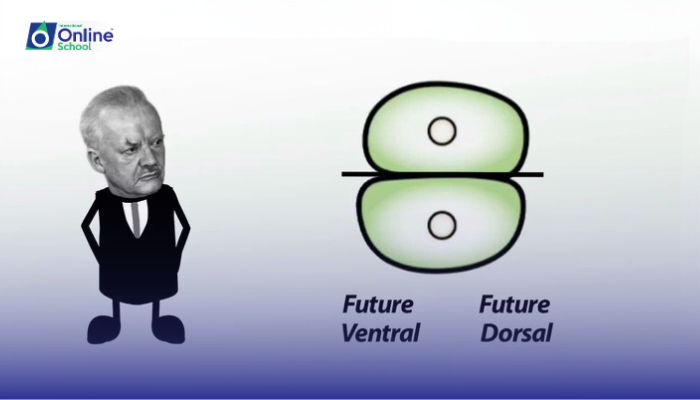
i. Identify Hans Spemann and his contribution to the discovery of embryonic induction.
ii. Explain the concept of embryonic induction and its significance in development.
iii. Discuss Spemann's key experiments and their role in understanding induction.
iv. Appreciate the impact of Spemann's work on the field of developmental biology.
Introduction:
Imagine a conductor raising their baton, coaxing a seemingly silent orchestra to erupt in a magnificent symphony. This is a metaphor for Hans Spemann's work in embryonic development. He, like a skilled conductor, revealed the hidden music within developing cells, uncovering the principle of induction, a concept that changed the way we understand how embryos take form.
i. The Conductor's Cue: Embryonic Induction Defined
Embryonic induction is the process by which one group of cells influences the fate of another, guiding its development into a specific tissue or organ. Imagine a group of cells in the frog embryo, like the organizer, playing the conductor's role. These cells release signaling molecules, like musical notes, that instruct nearby cells to become specific tissues like eye lenses or neural tubes.
ii. Spemann's Grand Experiment: The Organizer Takes Center Stage
Spemann's key experiment, conducted in the 1920s, involved transplanting a tiny piece of the organizer tissue from one frog embryo to another. He observed that the transplanted organizer, like a persuasive conductor, induced the formation of an extra eye lens in the host embryo. This dramatic result provided compelling evidence for the existence of induction.
iii. Variations on a Theme: Expanding the Symphony of Induction
Spemann's work wasn't limited to eye lenses. He and his collaborator, Hilde Mangold, conducted several experiments, each like a different movement in the developmental symphony, demonstrating induction's role in forming various organs like limbs and brain parts. They even explored the nature of the signaling molecules, the "musical notes" of induction, paving the way for future research into developmental signaling pathways.
iv. An Encore for Development: The Legacy of Hans Spemann
Spemann's work had a profound impact on developmental biology:
Conceptual Shift: It shifted the focus from pre-determined fates to the dynamic interactions between cells during development.
New Research Avenues: It opened doors for research into signaling molecules, gene expression, and the complex choreography of development.
Foundation for Modern Embryology: Spemann's work laid the groundwork for understanding how diverse tissues and organs emerge from a single fertilized egg.
Hans Spemann, like a gifted conductor, orchestrated a revolution in our understanding of embryonic development. His work on induction revealed the hidden melodies within developing cells, forever changing the way we view the magic of life unfolding within an embryo. His legacy continues to inspire scientists as we continue to explore the breathtaking symphony of life's earliest movements.
